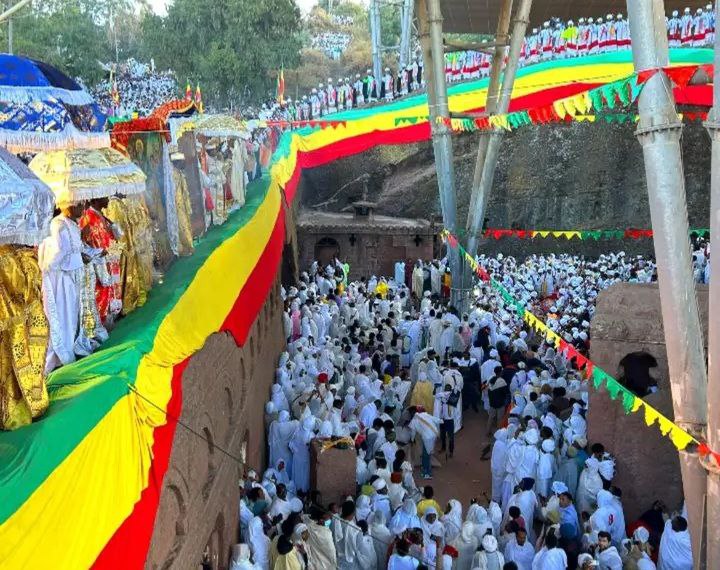
ADDIS ABABA - Thousands of worshippers gathered at Jan Meda on Monday as the Ethiopian Orthodox Tewahedo Church marked Timket (Epiphany) with colourful rituals, prayers and public blessings, reaffirming one of the country’s most cherished religious traditions.
Priests, clad in ornate vestments and carrying ceremonial crosses, were seen sprinkling holy water on the faithful during the early-morning ceremonies at Jan Meda, moments captured by the Gazette Plus camera. The ritual, symbolising purification and the baptism of Jesus Christ in the River Jordan, drew reverent silence followed by ululations and traditional chants from the assembled crowds.
The Jan Meda celebration, a focal point of Timket observances in the capital, brought together clergy, choirs, youth groups and families from across Addis Abeba. Traditional hymns accompanied rhythmic drumbeats as worshippers renewed their vows and sought blessings for the year ahead.
Beyond the capital, Gondar once again hosted its iconic Timket ceremonies around the historic Fasilides’ Bath, where thousands of pilgrims gathered for the ritual reenactment of Christ’s baptism. The centuries-old site, filled with consecrated water, became the centre of elaborate processions featuring tabots, sacred replicas of the Ark of the Covenant, carried under embroidered canopies.
In Lalibela, home to the famed rock-hewn churches, Timket was marked with deeply symbolic ceremonies that drew large numbers of pilgrims and visitors. Clergy led solemn processions through the ancient church complex, accompanied by prayers and hymns echoing across the historic stone sanctuaries, reinforcing Lalibela’s status as a spiritual heartland of Ethiopian Christianity.
Dessie also witnessed large gatherings as worshippers assembled around local water bodies for communal prayers and blessings. Religious leaders delivered sermons emphasising peace, unity and moral renewal, while choirs performed traditional chants reflecting the town’s long-standing religious heritage.
In Batu (Ziway), celebrations unfolded along the lakeshore, blending spiritual observance with local cultural expressions. Priests conducted blessings with holy water as congregations participated in prayers and communal rituals.
Recognised by UNESCO as an Intangible Cultural Heritage of Humanity, Timket continues to draw both local and international attention, reflecting Ethiopia’s deep-rooted religious identity and communal traditions.
Authorities reported calm celebrations across the sites, with security and municipal services coordinating to manage crowds and ensure smooth proceedings.
As the holy water dried on white shawls and colourful garments, many faithful described the day as a moment of spiritual renewal—an enduring testament to the living traditions that shape Ethiopia’s religious and cultural fabric.