By Dr. Biruk Terrefe (Rift Valley Institute, 2025)
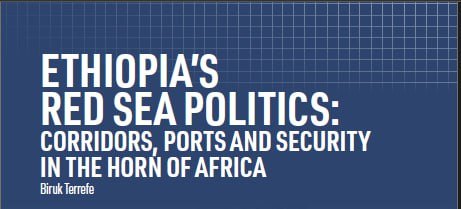
In Ethiopia’s Red Sea Politics: Corridors, Ports and Security in the Horn of Africa, Dr. Biruk Terrefe delivers a timely and incisive analysis of one of the most consequential geopolitical questions in the Horn of Africa today: Ethiopia’s renewed quest for access to the sea. Written against the backdrop of the January 2024 Memorandum of Understanding (MoU) between Ethiopia and Somaliland, the report interrogates the intersection of infrastructure, sovereignty, and security, offering a nuanced picture of how maritime politics is reshaping both the Ethiopian state and the wider region.
Scope and Framework
Published by the Rift Valley Institute under the Cross-Border Conflict Evidence, Policy and Trends (XCEPT) program, the study combines political economy, historical analysis, and regional geopolitics. It situates the 2024 MoU—reportedly granting Ethiopia a military and commercial presence along Somaliland’s coast—in a century-long continuum of Ethiopia’s attempts to overcome landlocked isolation since the loss of Eritrea in 1993.
Terrefe, a lecturer at the University of Bayreuth and a research associate at Oxford University, brings an interdisciplinary perspective grounded in his expertise on infrastructure and state formation. He demonstrates that Ethiopia’s maritime ambitions cannot be understood through economics alone; they are deeply enmeshed in security logics, identity politics, and historical narratives of empire and power.
Historical Continuities and Shifting Corridors
The first part of the report traces Ethiopia’s shifting relationships with coastal outlets—from the Franco-Ethiopian Railway (1917) connecting Addis Ababa to Djibouti, to the Assab corridor during the federation with Eritrea, and finally the post-1998 dependency on Djibouti. Terrefe shows how trade corridors have always functioned as political instruments, redistributing influence between state elites and peripheral communities.
Ethiopia’s reliance on Djibouti, while stable, has become economically burdensome and politically fragile. The study estimates that Ethiopia pays between USD 1.5 and 4 billion annually in port and logistics costs, while infrastructural bottlenecks and poor road maintenance on the Djiboutian side exacerbate delays and inefficiencies. These challenges have prompted successive governments to diversify port access—most notably through Berbera (Somaliland), Port Sudan, and Lamu (Kenya).
Terrefe convincingly argues that the MoU with Somaliland represents both continuity and rupture. It revives the long-standing ambition to break dependence on Djibouti but introduces new layers of militarization and recognition politics, transforming what was once a logistical issue into a matter of sovereignty and existential security.
The Somaliland MoU: Port-for-Recognition Diplomacy
At the heart of the report lies the controversial Ethiopia–Somaliland MoU, signed in January 2024. Although details remain undisclosed, Terrefe reconstructs its contours from official statements, leaks, and interviews. The deal reportedly allows Ethiopia to lease a 20-kilometre coastal strip—possibly near Berbera—for military and commercial use, in exchange for possible recognition of Somaliland’s independence and a share in Ethiopian Airlines.
The agreement triggered immediate diplomatic backlash: Somalia expelled Ethiopia’s ambassador and accused Addis Ababa of violating its sovereignty, while regional and international actors expressed concern. Yet, from Ethiopia’s perspective, the move reflects a calculated strategic gamble—a response to perceived encirclement by Egypt, Eritrea, and hostile Red Sea powers.
Terrefe situates the MoU within Ethiopia’s broader “Red Sea Doctrine”, articulated by Prime Minister Abiy Ahmed in his 2023 parliamentary lecture “From a Drop of Water to Sea.” Abiy’s framing of maritime access as a national survival issue effectively securitizes the agenda, placing it beyond debate. The report interprets this as a classic case of discursive securitization, in which economic policy is reframed as an existential necessity to justify extraordinary action.
The Red Sea Doctrine and Abiy’s Grand Strategy
One of the book’s most insightful contributions is its dissection of Abiy Ahmed’s ideological project. Drawing from speeches and policy documents, Terrefe argues that Abiy’s maritime ambition is part of a grand strategy of nation-building and regional power projection.
The Prime Minister’s rhetoric, invoking the legacy of the Aksumite Empire and historic Ethiopian generals like Ras Alula, positions Ethiopia as a “civilizational state” destined for great-power status. Access to the Red Sea becomes not merely an economic or logistical necessity, but a symbol of Ethiopia’s rightful place in world history. Abiy’s claim that Ethiopia could become “one of two global superpowers by 2050” captures the utopian element in this narrative.
Terrefe deftly links this ideological framing to Ethiopia’s shifting alliances. He notes that Addis Ababa’s exclusion from the 2020 Council of Arab and African Coastal States of the Red Sea—led by Saudi Arabia and Egypt—deepened the government’s sense of marginalization. Ethiopia’s subsequent efforts to join BRICS, the Organization of Islamic Cooperation, and even the Arab League are seen as attempts to reassert regional influence. Meanwhile, Ethiopia’s naval revival program, first initiated with French support and later pursued with Russian collaboration, underscores the government’s determination to establish a maritime presence, regardless of international opposition.
Infrastructure, Security, and Sovereignty
Terrefe’s central thesis is that infrastructure and sovereignty are co-produced. Ports, railways, and corridors are not neutral economic tools; they are arenas where power, identity, and territorial control are contested. The Berbera corridor, for example, is both a commercial lifeline and a geopolitical bargaining chip—entangled with UAE investments, British financing, and Somaliland’s search for recognition.
The report’s analysis of dual-use infrastructures—facilities serving both military and civilian purposes—is particularly compelling. Ethiopia’s prospective naval base near Berbera, built alongside commercial terminals, exemplifies the fusion of trade and security. Such arrangements, Terrefe warns, blur the boundaries between economic cooperation and militarization, potentially destabilizing the region while inviting foreign involvement from the UAE, Türkiye, and Russia.
Sub-National Dimensions and Internal Politics
Beyond geopolitics, Terrefe pays close attention to the domestic ramifications of Ethiopia’s maritime strategy. Trade corridors shape sub-national economies and ethnic relations, empowering some communities while marginalizing others.
Abiy’s references to shared Afar and Somali identities across borders—framing their exclusion from the Red Sea as historical injustice—serve to mobilize nationalist sentiment and legitimize his agenda. Yet, Terrefe observes that such narratives risk instrumentalizing ethnicity for geopolitical gain, while diverting attention from Ethiopia’s internal crises in Amhara, Oromia, and Tigray. For many critics, the Red Sea project functions as a distraction from domestic fragility, designed to rally unity through external ambition.
Analytical Strengths
Terrefe’s report stands out for its methodological rigor and multi-scalar analysis. Drawing on field interviews, government briefings, and regional data, he weaves together local, national, and international perspectives. His argument that Ethiopia’s “trade corridors transcend their role as conduits for goods” captures the essence of his broader thesis: that infrastructure is politics by other means.
The writing is measured yet critical. Terrefe avoids polemics, instead presenting Ethiopia’s Red Sea ambitions as both rational and risky—a logical response to structural constraints, yet potentially destabilizing if pursued through unilateralism. His historical depth, particularly in linking Menelik’s railway diplomacy to Abiy’s Red Sea doctrine, gives the report remarkable coherence.
Limitations and Critique
While the report is deeply informative, its brevity (under 50 pages) sometimes leaves important questions underexplored. For instance, the internal decision-making process within Abiy’s administration remains opaque—how consensus (or dissent) was managed among military, diplomatic, and economic elites is not fully addressed. Similarly, the perspective of Somaliland’s domestic actors—beyond its leadership—is treated more analytically than empirically.
Moreover, Terrefe’s focus on Ethiopia’s agency occasionally sidelines the regional reactions of states like Eritrea and Djibouti, whose responses will be crucial to the future of the Red Sea order. Still, these are less omissions than invitations for further research.
A Foundational Study on the Horn’s New Geopolitics
Ethiopia’s Red Sea Politics is an outstanding contribution to understanding the new maritime geopolitics of the Horn of Africa. It moves beyond the sensationalism surrounding Abiy’s “sea speech” and the Somaliland MoU, situating them within a longer and deeper continuum of infrastructural statecraft, security anxieties, and regional realignment.
Terrefe’s central insight—that Ethiopia’s corridors and ports are sites of political negotiation, not merely transport routes—challenges scholars and policymakers alike to rethink how development and security intertwine. The report’s significance lies not only in documenting events but in explaining the logic behind them: how a landlocked nation reimagines its destiny through the lens of the sea.
In an era when the Red Sea has become a global fault line connecting African, Middle Eastern, and great-power interests, Terrefe’s work offers both clarity and caution. It is an essential read for diplomats, researchers, and anyone seeking to understand how Ethiopia’s maritime ambitions could redefine the Horn of Africa—for better or worse.