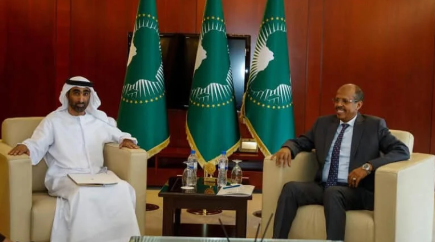
Addis Ababa — The United Arab Emirates (UAE) and the African Union (AU) jointly reaffirmed their commitment to the sovereignty, territorial integrity and stability of the Federal Republic of Somalia, in a statement issued Tuesday following high-level talks in Ethiopia’s capital. The declaration comes amid mounting diplomatic tensions triggered by Israel’s controversial recognition of Somaliland and growing speculation over the UAE’s role in Horn of Africa geopolitics.
The joint communiqué, issued after a meeting between UAE Minister of State Sheikh Shakhboot bin Nahyan Al Nahyan and AU Commission Chairperson Mahmoud Ali Youssouf, underscored shared priorities in security cooperation, economic integration and regional stability. Both sides reiterated unwavering support for Somalia’s unity “in accordance with international law and the AU Constitutive Act.”
The reaffirmation follows a cascade of diplomatic developments that shook the Horn in recent weeks. On December 26, 2025, Israel became the first sovereign nation to formally recognize Somaliland as an independent state, a region that declared independence from Somalia in 1991 but lacked international recognition. The move, hailed in Hargeisa as a milestone, drew swift condemnation from Mogadishu, the African Union, Arab and Islamic states, and several international actors who viewed it as a challenge to Somalia’s territorial integrity.
The situation escalated further on January 6, 2026, when Israeli Foreign Minister Gideon Saar made a historic visit to Somaliland’s capital, Hargeisa — denounced by Somalia as an “unauthorized incursion” and a violation of national sovereignty. Somalia’s Ministry of Foreign Affairs has since appealed to the United Nations and the AU to reaffirm support for its territorial unity in response to the diplomatic breach.
Somalia’s political leadership has also signaled deepening frustrations with Gulf state diplomacy. Relations with the UAE, once among Mogadishu’s closest partnerships, have visibly eroded, with Somali officials reportedly considering a formal downgrade in ties over perceived UAE influence in Somaliland and related security dynamics.
The AU Peace and Security Council — backed by the joint AU-UAE statement — has urged Israel to revoke its recognition of Somaliland, describing the unilateral move as illegal and destabilizing under continental norms and the UN Charter.
Regional observers note that the flare-up has external dimensions beyond Horn politics, touching broader Red Sea and Middle East alignments. Israel’s engagement in Somaliland is widely interpreted as strategic positioning near key maritime corridors, while Gulf powers such as Saudi Arabia, Egypt and Turkey have amplified calls for respect of established borders.
As diplomatic fault lines deepen, Addis Ababa — having hosted the AU-UAE talks — remains a fulcrum for mediation and security cooperation in the Horn. Analysts say outcomes of ongoing negotiations could influence regional trade, counter-terrorism efforts, and power balances along one of the world’s most contested geopolitical frontiers.