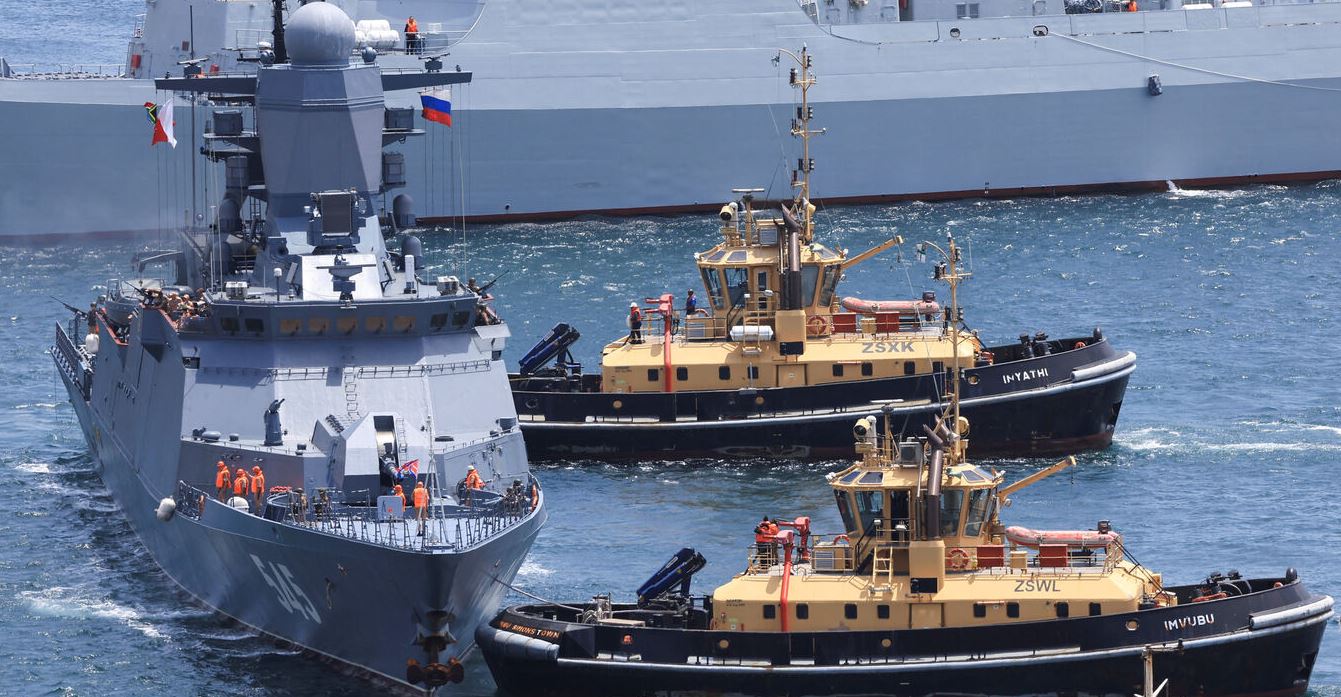
CAPE-TOWN:- China, Russia and Iran have launched a week-long BRICS Plus naval exercise in waters off South Africa’s coast, underscoring the growing security and defence cooperation among emerging powers amid heightened global geopolitical tensions.
The drills, taking place in the Indian Ocean and the Atlantic approaches near South Africa, are framed by participating countries as routine maritime security exercises focused on search-and-rescue operations, anti-piracy measures and coordination at sea. However, analysts view the exercise as carrying broader strategic significance, reflecting shifting global alignments and a more assertive posture by non-Western powers.
South Africa’s defence authorities confirmed the commencement of the drills, noting that the exercise aims to enhance interoperability, share operational experience and strengthen maritime security cooperation among BRICS Plus partners. The “Plus” format reflects the bloc’s expanding scope, following the recent inclusion of new members and partners beyond the original BRICS grouping of Brazil, Russia, India, China and South Africa.
Naval assets from China, Russia and Iran are participating in the exercise, alongside South African naval elements providing logistical and operational coordination. Military officials emphasised that the drills are not directed at any specific country and fall within the framework of international maritime law.
“This is about cooperation, skills transfer and ensuring the safety of vital sea lanes,” a South African defence official said. “South Africa routinely conducts joint exercises with a wide range of international partners.”
Despite official assurances, the exercise has drawn scrutiny from Western governments and security analysts, particularly given Iran’s involvement and Russia’s ongoing war in Ukraine. The presence of Chinese and Russian warships in southern African waters has revived debate over South Africa’s foreign policy posture and its long-standing principle of non-alignment.
South Africa has sought to balance its historical ties with Western partners against deepening economic and political relations with BRICS members. The country has repeatedly defended its participation in joint military exercises with Russia and China, arguing that it conducts similar engagements with NATO countries and other international partners.
For China and Russia, the drills reinforce their strategic outreach to the Global South and their interest in securing maritime routes critical to trade and energy supplies. Iran’s participation signals its growing efforts to break diplomatic isolation and project naval presence beyond the Middle East.
The exercise also comes at a time when BRICS is positioning itself as an alternative platform to Western-led institutions, with a growing emphasis on security cooperation alongside trade, finance and development. While BRICS has not formally established a collective defence framework, joint military activities have become more frequent in recent years.
Maritime security experts note that the Indian Ocean region has gained renewed strategic importance due to global trade flows, energy shipments and undersea communication cables. Increased naval activity by major powers reflects competition for influence in these waters, particularly as tensions persist between the United States and its allies on one side, and China and Russia on the other.
Domestically, the drills have sparked political debate in South Africa, with opposition parties questioning the diplomatic costs of hosting exercises involving sanctioned states. The government, however, maintains that its foreign policy remains guided by strategic autonomy and multilateral engagement.
As the BRICS Plus naval drills continue through the week, they highlight the increasingly complex security dynamics shaping global politics — and the growing role of emerging powers in redefining cooperation beyond traditional alliances.